 University of Nevada, Reno
Sam Houston and the Texas Rangers
The Texas Rangers began as state troops and evolved into a policing militia. Born from the need for protection on a wild and warring Texas frontier, the Rangers became one of the most colorful, efficient, and deadly bands of irregular law-enforcing partisans. Founding Father and President of the Texas Republic Sam Houston proliferated the Ranger companies.
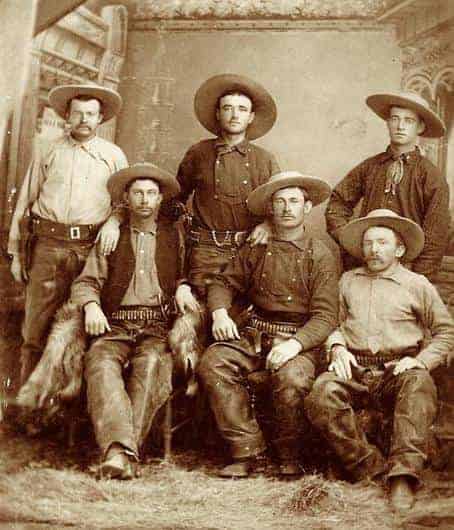
Header Image: Texas Rangers ca. 1860; courtesy Wikimedia Commons [1].
“Do right and risk the consequences.”

Sam Houston portrait; author Matthew Brady courtesy Library of Congress
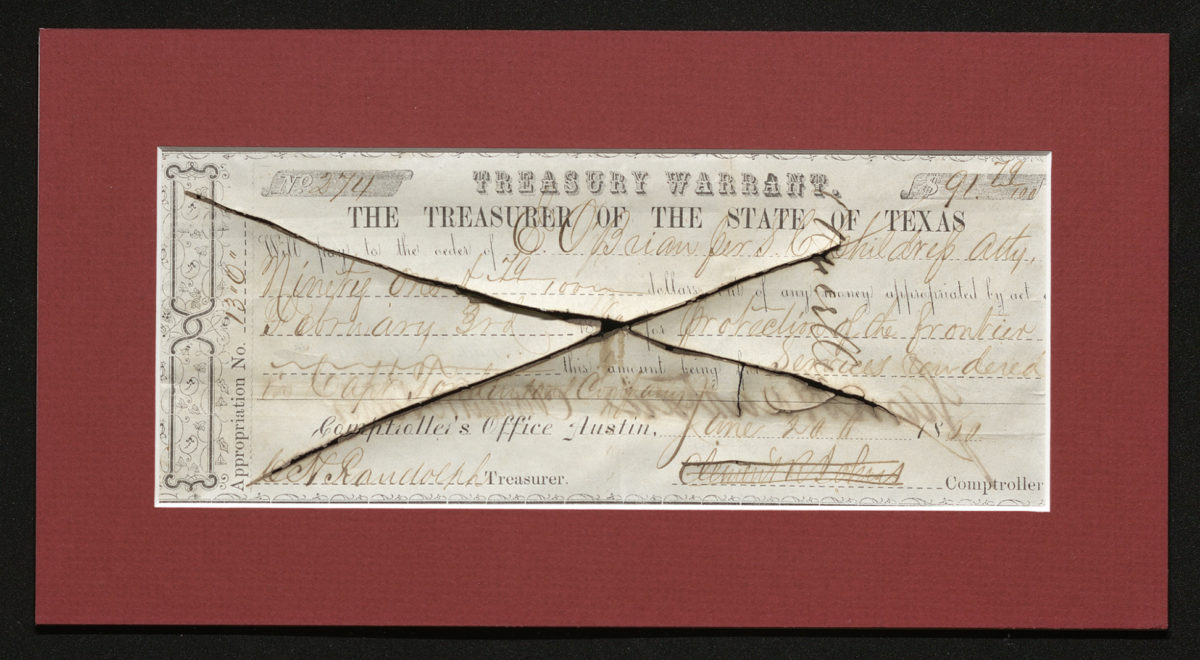
Not a lot is known about Texas Treasury Warrants from the period between Texas’s annexation in 1845 and its secession in 1861 (like this one in our collection from 1860). Texas produced a number of bearer warrants with specific values—$1, $5, $10—that could served as a stand-in for currency, but this particular warrant had a payment of $91.79 written in. It most likely was payment to a soldier in the Texas Rangers, as the reason given for the payment is “protection of the frontier,” and “services rendered to Capt. Tomlinson’s Company.” The warrant also notes that the payment was made based on money appropriated by the act of February 3rd, 1860, which provided funds for military services rendered.
Captain ‘Tomlinson’ may be a misspelling of ‘Tumlinson,’ a prominent family in the history of the Texas Rangers. The Tumlinson brothers, John, Joseph, and Peter all became involved in protection of the frontier after their father was killed by Native Americans in 1823. The brothers, along with thirteen other members of the Tumlinson family, all served in the Texas Rangers. This warrant would likely be referring to Captain Peter F. Tumlinson, who led a company of Texas Rangers against Don Juan Cortina late in 1859, after Cortina attempted to brutally wrest control of the lower Rio Grande Valley from Texas.
This warrant has been signed by Texas State Treasurer Cyrus H. Randolph, Comptroller Clement R. Johns, and most importantly, Governor Sam Houston, whose signature appears on the back of the document. Sam Houston—for whom Houston County, Texas, the city of Houston, and numerous towns, institutions, and parks are named—led Texan forces to victory against General Santa Anna at the Battle of San Jacinto in 1836. Houston’s army took Santa Anna’s forces by surprise and soundly defeated them in a mere eighteen minutes. Santa Anna was forced to sign the Treaties of Velasco, which granted Texas Independence while also condemning Santa Anna to exile.
Sam Houston served as the first and third president of the Republic of Texas, and oversaw the annexation of Texas to the Union in 1845. He served as a United States senator until he ran for governor in 1859 (and is the only American to have served as governor in two states as he was governor of Tennessee from 1827-29). His tenure as governor of Texas was cut short in 1861, when Texas seceded from the Union. Though Houston owned slaves and opposed abolition, he was a unionist and refused to take an oath of allegiance to the Southern Confederacy (being the only governor in the South to do so). He was removed from office and although he was offered to lead Union troops in the South, he declined and died of pneumonia two years later. (Scroll down to continue reading about Sam Houston below)
Sometimes referred to as the “George Washington of Texas,” Houston had a colorful temperament and was once even known to have chased a Congressman down the street and beat him with a cane after he accused Houston of fraud on the House of Representative floor. He lived with Cherokee and had a tribal marriage to a Cherokee woman early in his youth. He would become a spokesman between the tribe and US government and later fought for Native American rights in Congress, sometimes even wearing Cherokee regalia to Senate meetings.
Houston is best known for his role in Texas Independence from Mexico. As Commander-in-chief of the Texas Army, Houston led his troops on April 21, 1836, in the Battle of San Jacinto, catching General Antonio López de Santa Anna by surprise on the San Jacinto River. This battle, said to have only lasted 18 minutes with Houston’s army of 800 against Santa Anna’s of 1600, was one that led to Santa Ana’s surrender and Texas Independence. Houston was later elected as the Republic of Texas’ first President with its first capital named Houston, although the capital moved to Austin (named for Stephen Austin) years later.
The Rangers were to be described many times, at first as state troops and later as a police force or constabulary. During most of the 19th century, they were neither. They were apart from the regular army, the militia or national guard, and were never a true police force. They were instead one of the most colorful, efficient, and deadly band of irregular partisans on the side of law and order the world has seen. They were called into being by the needs of a war frontier by a society that could not afford a regular army. Texans passed in and out of the Rangers regularly; in the early years a very high proportion of all west Texans served from time to time. If they bore certain similarities to Mamelukes and Cossacks, they were never quite the same.