 University of Nevada, Reno
George McClellan: Scientist, Politico, and Union Hero
George B. McClellan discovered copper deposits in a north Texas river while part of the Red River expedition of 1852. He would later return to the area to attempt to develop the site into a profitable venture.
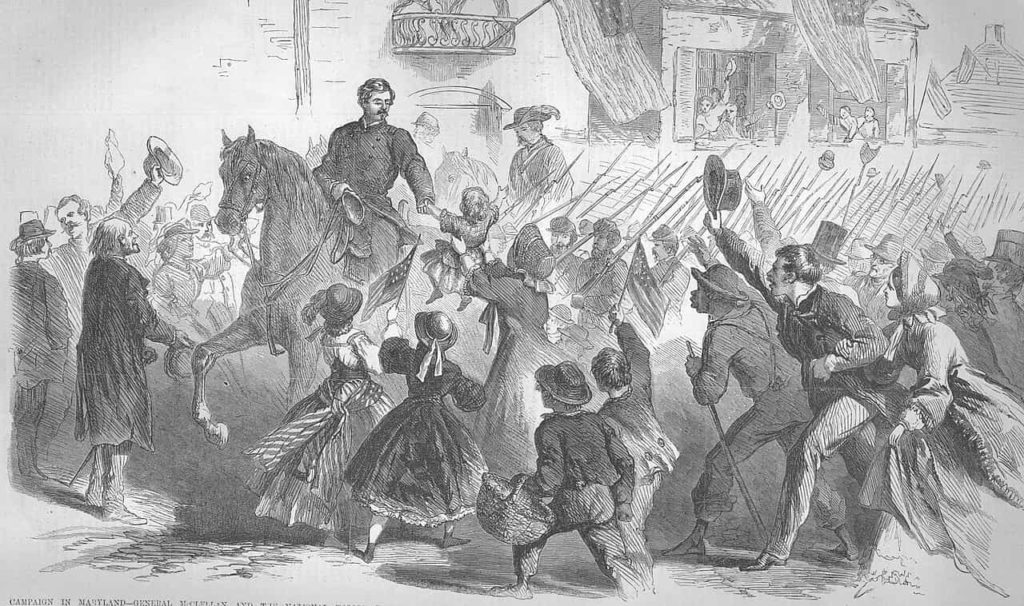
Header Image: General McClellan just before the Battle of Antietam; author Frank Leslie's Illustrated Newspaper courtesy Wikimedia Commons [1].
“All quiet along the Potomac.”

George B. McClellan meets with Abraham Lincoln at Antietam; courtesy Wikimedia Commons
George B. McClellan (1826-1885), who has signed this certificate as president of the Grand Belt Copper Company, is best known for his military service in the Mexican War and the American Civil War, where he organized and commanded the Army of the Potomac for Union forces. Throughout his career, McClellan was popular with the men he led but locked horns with other leaders and politicians—President Lincoln included. McClellan challenged Lincoln as Democratic nominee for president in the election of 1864 but lost.
Prior to his service in the Civil War, McClellan was a member of Randolph B. Marcy’s Red River expedition of 1852. McClellan collected meteorological, biological, and geological samples of the regions that the party explored. This expedition proved fortuitous in two ways: McClellan ended up marrying Marcy’s daughter, and he discovered copper deposits in the river in Northwest Texas. After his bid for the presidency failed, McClellan returned to the area to more seriously prospect a mine.
The Grand Belt Copper Company was organized in 1877 and purchased 200,000 acres of land in present-day Hardeman County. McClellan traveled to the mine site with an entourage and supplies including fine furniture and a full-sized metal bathtub, altogether requiring over 200 horses to haul. This extravagance was perhaps a sign of things to come with the financial management of the mine. (Scroll down to continue reading about the Grand Belt Copper Company below)
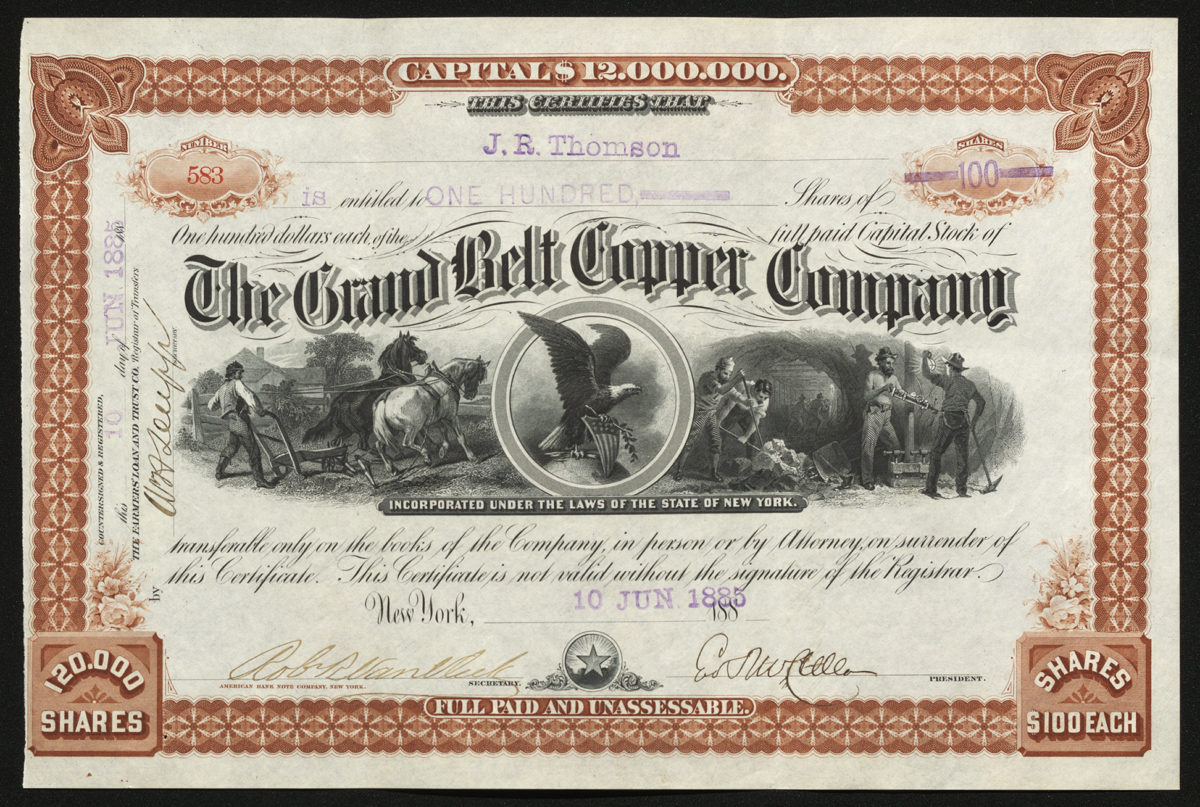
The site was not particularly productive, and challenges with transportation, fuel, and water availability further hampered the mine’s success. Operations were abandoned a few years after McClellan’s death, and the company defaulted on mortgage payments for the land. The State of Texas brought a foreclosure lawsuit against the company in the late 1880s. A 1907 issue of United States Investor later identified the mining company as “merely a paper company” that “never owned any property. It was just a ‘wild-cat’ scheme to get copper from a river… the stock is absolutely worthless.” Today the stock certificate’s value comes from the fact it bears McClellan’s signature; it was signed by him in June of 1885, just months before his death in October.
This stock certificate features a few motifs common to vignette designs. In the center, and eagle perches atop North American on the globe, clutching a U.S. shield and olive branch (symbolizing peace) in one claw, and a bundle of arrows (symbolizing war) in the other. To the right is an image of mining operations, and to the left a more pastoral scene alluding to agriculture. In it, a man works a horse-drawn plow led by two horses, one white and one black. This is a reference to Plato’s Allegory of the Chariot, wherein the steeds symbolize the internal struggle. The black horse represents irrational impulses, pulling the chariot in different directions, while the white horse represents moral and noble passions. At the bottom center of the certificate is a star, likely a reference to the mine’s location in Texas.